The art of celadon ceramics has long been revered as one of Korea's most significant cultural achievements, with the delicate crackle patterns of Goryeo dynasty celadon standing as a testament to centuries of masterful craftsmanship. In recent years, researchers and digital artists have turned their attention to recreating these intricate crackle textures through algorithmic generation, blending ancient artistry with cutting-edge computational techniques.
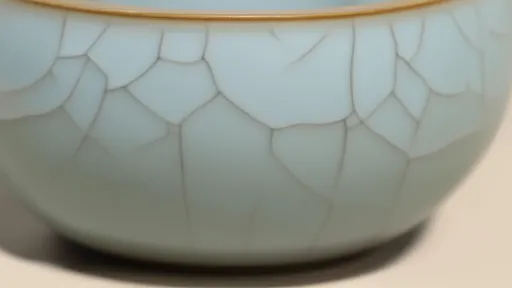
At the heart of this technological pursuit lies the challenge of capturing the organic complexity of natural crackle formations. Traditional Goryeo celadon exhibits a distinctive network of fine cracks called "geukjil" that develop during the cooling process due to differences in thermal contraction between the glaze and clay body. These patterns aren't random - they follow physical principles of fracture mechanics while maintaining an aesthetic balance that has captivated collectors for generations.
Material scientists have discovered that the crackle patterns in authentic Goryeo celadon follow specific mathematical relationships between line thickness, intersection angles, and propagation paths. When examining high-resolution scans of museum pieces, researchers identified recurring fractal-like properties where larger cracks branch into progressively finer networks. This hierarchical structure gives the glaze its characteristic depth and visual complexity.
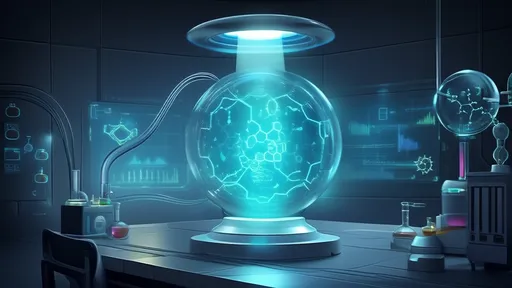
The algorithmic recreation process begins with physical simulation models that account for the material properties of traditional celadon glazes. By inputting data on thermal expansion coefficients, viscosity at different temperatures, and cooling rates used by Goryeo potters, researchers can generate base crackle patterns that follow natural fracture mechanics. However, these simulations alone produce patterns that, while physically accurate, lack the subtle imperfections and artistic balance of historical pieces.
What makes the Korean approach distinct is the incorporation of aesthetic principles derived from careful study of surviving Goryeo celadon. Algorithms are trained on thousands of glaze images to learn the visual "grammar" of traditional crackle patterns - the preferred spacing between major cracks, the typical branching angles, and the way cracks interact with decorative elements like inlaid designs. This machine learning component helps bridge the gap between physical simulation and artistic tradition.
Contemporary ceramic artists working with these digital tools report fascinating results. The generated patterns serve as both inspiration and practical guides for creating new works that honor traditional aesthetics while allowing for modern interpretation. Some artisans use the algorithms to plan glaze compositions and firing schedules that will produce desired crackle effects, while others apply the patterns digitally to ceramic surfaces before physical production begins.
The implications extend beyond art preservation and into materials science. By reverse-engineering the crackle formation processes, researchers gain new insights into historical ceramic techniques that were never formally documented. This knowledge could lead to improved conservation methods for fragile celadon pieces and even inspire new composite materials that harness controlled crack propagation for functional or decorative purposes.
As the technology develops, ethical questions emerge about the relationship between digital recreation and traditional craftsmanship. Some purists argue that algorithmically generated patterns can never capture the spiritual essence of celadon making - the intuition developed through years of apprenticeship and the subtle variations that make each historical piece unique. Others see the technology as a valuable tool for cultural transmission, allowing new generations to engage with traditional aesthetics in innovative ways.
The most successful applications of crackle pattern algorithms seem to strike a balance between technological precision and human artistry. In several collaborative projects, digital pattern generation serves as a starting point that master potters then modify and refine through traditional techniques. This hybrid approach maintains the irreplaceable human element while leveraging computational power to explore new creative possibilities within the celadon tradition.
Looking ahead, researchers are working to make the algorithms more accessible to working ceramic artists through user-friendly interfaces. The goal isn't to replace traditional skills but to provide new tools for experimentation. Early adopters report that working with these digital models has actually deepened their understanding of traditional crackle glazes, helping them appreciate the complex interplay of material science and artistic vision that Goryeo potters mastered centuries ago.
Museums have begun incorporating algorithmic crackle visualizations into their celadon exhibits, allowing visitors to interact with digital representations that demonstrate how subtle changes in composition or firing technique would affect the final pattern. These educational applications help bridge the gap between modern audiences and ancient craft techniques, making the sophisticated artistry of Goryeo celadon more comprehensible to contemporary viewers.
The intersection of traditional Korean ceramics and modern algorithm design represents more than just technical innovation - it's a fascinating dialogue between past and present. As the technology continues evolving, it promises not only to preserve the visual legacy of Goryeo celadon but also to inspire new forms of artistic expression rooted in this rich cultural heritage. The crackle patterns that once emerged unpredictably from master potters' kilns may now be modeled with remarkable precision, yet they still retain their power to captivate and inspire.

By /Jul 25, 2025
By /Jul 25, 2025

By /Jul 25, 2025
By /Jul 25, 2025

By /Jul 25, 2025
By /Jul 25, 2025
By /Jul 25, 2025
By /Jul 25, 2025
By /Jul 25, 2025
By /Jul 25, 2025

By /Jul 25, 2025

By /Jul 25, 2025
By /Jul 25, 2025

By /Jul 25, 2025
By /Jul 25, 2025

By /Jul 25, 2025

By /Jul 25, 2025
By /Jul 25, 2025
By /Jul 25, 2025

By /Jul 25, 2025
